

Where does the international fight to defeat the US economic and political war on Cuba stand after the UNGA vote and the US elections? by Ike Nahem
PREFACE
The analysis below was largely written before the November 3, 2026, Congressional, state, and local elections in the United States with its political humiliation of Donald Trump’s Republican Party and the concurrent elevation of the Democratic Party into large majorities in the US House of Representative and Senate and nationwide. I am including a brief “Afterward “to this essay with some initial thoughts on how this new terrain in US electoral politics impacts on the multi-front and overall united-front efforts of our growing Cuba solidarity and anti-blockade movement to defeat the US economic and political war ‒ and continual military threats ‒ against our Caribbean neighbor of Cuba and achieve genuine US-Cuba normalization.
Behind the Numbers
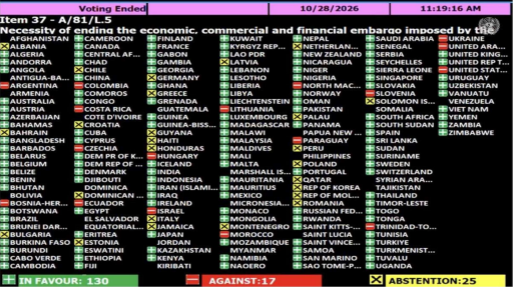
How do we analyze -- and infer the likely consequences and dynamics from -- the recent 130-17-25 vote in the Cuban-sponsored United Nations General Assembly (UNGA) Resolution A/81/L.5 on the “Necessity of ending the economic, commercial, and financial embargo imposed by the United States of America against Cuba.”? This remains clearly an overwhelming majority of UN member states for the 35th time since 1994.1 But it is also true that Trump-Rubio-Washington ‒ one week before Trump’s November 3, 2026, electoral debacle -- went on a full-throttle political pressure campaign that did make some gains which I will look at in detail below. Such overt (and who knows how many covert?) threats and bullying 6 played out in the inimitable Trumpian style of bombast and bluster in the weeks leading up to the UNGA vote.
The UNGA vote included a wave of feckless “abstentions” across the Caribbean, Central America, and the South American continent; public splits in the European Union; and selective other “defections” in West Asia- Middle East and elsewhere. All these votes on the floor of the UNGA were certainly subject to the power of US and “multinational” capital on their economic and financial circumstances and conditions. Of course, the “No” votes of some US allies, e.g. Milei’s Argentina, de la Estrella’s, Colombia, the King of Morocco and others needed no particular pressure in voting with Washington as they are united in their class and ideological hatred of revolutionary, socialist Cuba (and in the case of the Moroccan monarchystate, Cuba’s steadfast support of the oppressed Sahrawi people’s right to self-determination and independence).
“Spin” in the US capitalist media emphasizes the relative rise of alignment with US anti-Cuba policy in the 2026 UN vote. The pro-blockade Miami Herald headlined “After standoff with the U.S., Cuba wins embargo vote but loses support at UN” and the UN’s own media outlet (UN News) put it like this: “Backing for UN call to end Cuba embargo falls to 20-year low.” The implication is that acquiescence to US anti-Cuba policy was - - at least across the Americas -- on an apparently unstoppable ascendancy after a string of some seven conservative, “libertarian,” or rightist (all posing as “populist”) electoral victories in recent years. This certainly has put into executive power political forces from the neocolonial and neoliberal national